

-
0:00/21:16
“In the wake of recent disaster events, countless arts and cultural artifacts, workspaces and community events critical to the state’s history, culture and economy were damaged, canceled or destroyed." — Leah Hamilton
When Disaster Strikes the Arts

Following the violent tornados of ‘21 in Western Kentucky and the catastrophic flooding in Eastern Kentucky in ’22, many artists and arts organizations sought guidance on how to better prepare for future disasters. (Photo by Kentucky Tourism, Arts and Heritage Cabinet)
By Tom Martin
Anybody who paints, sketches, performs, sculpts or invests themselves in some form of artistic expression surely felt a pang as images of devastation and loss began emerging from areas of Western Kentucky decimated by tornados in the winter of 2021, followed only a year later by scenes of catastrophe from the flash flood that struck Southeastern Kentucky in the summer of '22. It takes time to recover from the shock and trauma, and to reflect on the lessons presented by such calamities.
Now, in the fall of 2024: signs of recovery and of forethought.
That is the focus of an in-depth report, “Kentucky Arts in Disaster: An Impact Report,” described by author Leah Hamilton, Assistant Professor of Arts Administration at the University of Kentucky, as “a collection of stories and data from Kentucky artists, craftspeople, artisans, arts managers, teaching artists, arts community leaders, arts board volunteers, arts funders and governmental agency representatives — all affected by the compounding events of natural disasters in Kentucky in 2021 and 2022.”
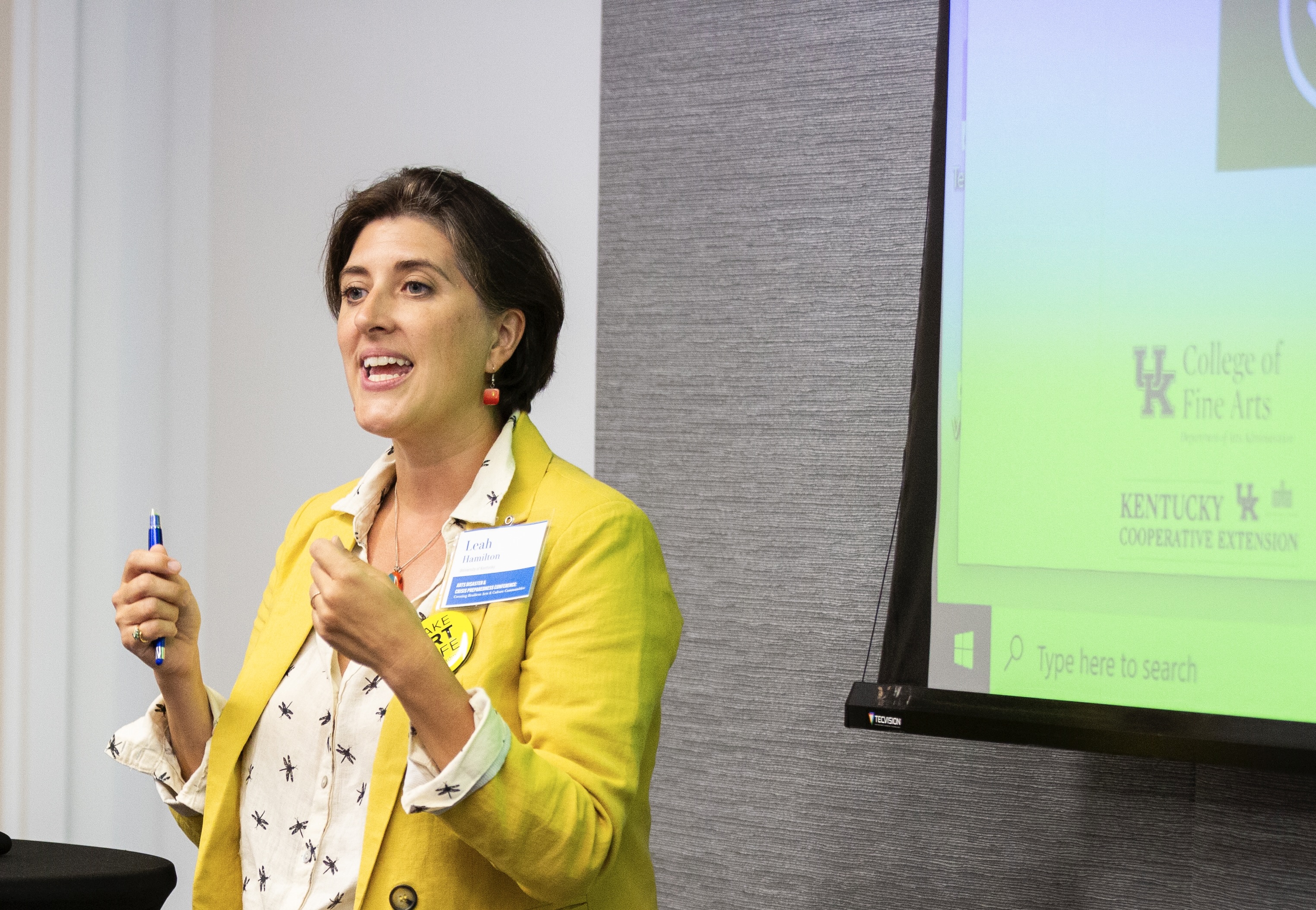
Professor Leah Hamilton at Arts Disaster and Crisis Preparedness Conference (Photo by Arden Barnes, 2024)
I talked with professor Hamilton about her report for an upcoming edition of the WEKU current affairs program, Eastern Standard. You can listen to and read a transcript of our conversation below. The interview has been edited for clarity and length.
Tom: With us here in the studio is the report's author, Leah Hamilton, Assistant Professor of Arts Administration at the University of Kentucky. We thank you, Leah, for taking time to talk with us about the findings that are contained in this report.
Leah: Thanks for having me today.
Tom: (Your report) seems all the more vital at a time when it's clear that severe — even extreme — weather events are becoming more frequent in our world. I'm wondering, was that a motivation to do this work?
Leah: Certainly. I think there were some compounding events in Kentucky, as I know you covered so well. But particularly between 2020 and 2022, there were seven federally declared disasters in the state. And of course, two of those were well-covered in the media and had widespread damage. But again, those were compounded by the pandemic, and I think these factors led to those in arts communities reaching out to the Kentucky Arts Council in particular, requesting the need for assistance and resources. Having these two specific disasters in Western Kentucky with the tornadoes and then Eastern Kentucky with the flooding within seven months of each other, it really heightened an awareness for those state agents working at the Arts Council and also at the Humanities Council that, wow, we need to focus on how we can do better in the future. Because I think it caught everyone off guard in the arts community and in the cultural heritage community too.
Tom: For sure, and stretched resources and so forth.
Leah: Exactly.
Tom: A lot of people were involved in gathering data and making observations for this report. You note in the report that every effort was made to use present, current and correct information as of April 2024, and I wondered if you could just tell us briefly a little bit more about that. I think it helps the listener recognize the strength of these findings.
Leah: So there are two viewpoints on this. One is as a researcher, I approach everything with this belief that I don't want, especially with disaster situations, to be this objective, rational observer. I really believe in letting the stories of those directly involved come to light. It's sort of my — I guess you could say I come from a very humble place of just wanting to bring those stories to light. Also, this particular report was aimed at policymakers and funders to say, here are some ways that we can do better for our arts communities in terms of disaster relief and recovery.
So I wanted to make sure that those that are reading the report know that policies are changing every day. As you know, the political climate and its coverage means that things are changing. Even since the report came out in April of 2024, there have been some policy changes that have occurred. So I wanted the readers to know that these are the stories of real Kentucky artists, craftspeople, educators, that I just had the honor of compiling their stories, and also that a lot is changing all the time, so we'll just keep a pulse on it. But those policies that I directly address in here, we're seeing some positive change already.
Tom: Okay, let's dig into it just a little bit and jump to page 18, the summary of findings, and first look at areas of losses, because that gives us a good sense of how devastating these events can be for working artists. In our coverage area, Appalshop in Whitesburg (which recently received a National Humanities Medal at a White House ceremony) is a good example. Of course, Hindman Settlement School as well. But Appalshop in Whitesburg is an example of the devastation that was brought by the flood of '22. What can you tell us about what they experienced?
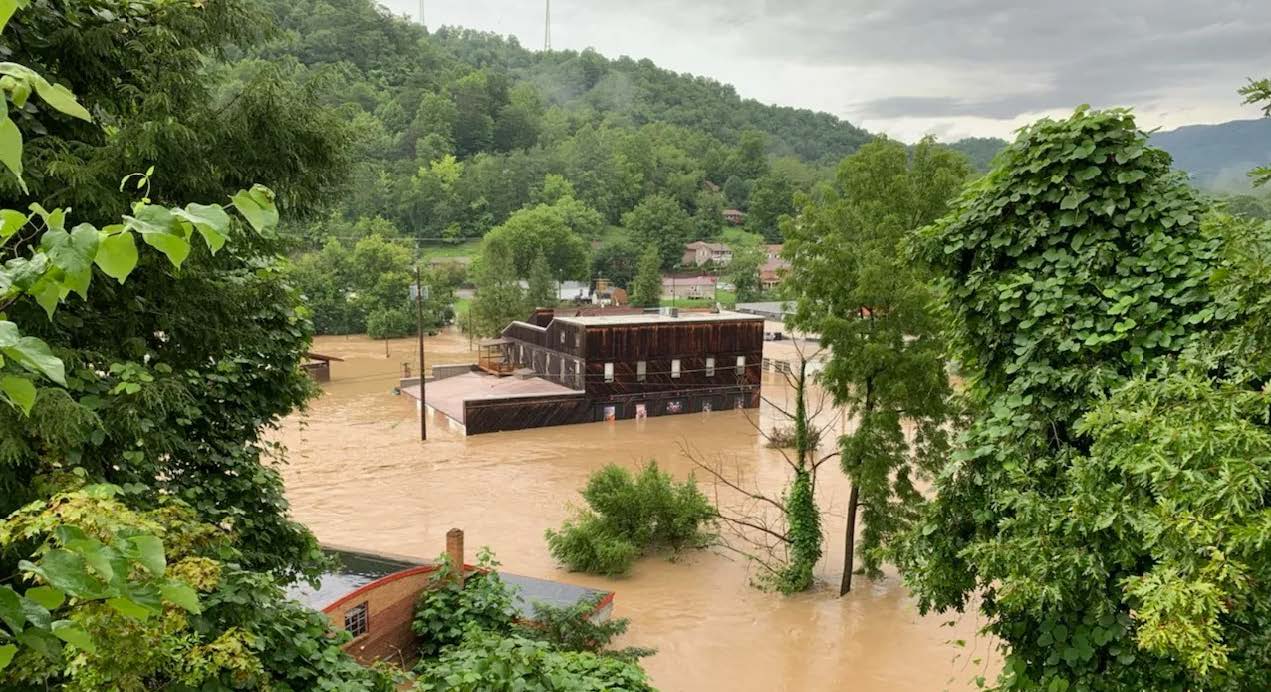
Ultimately, the Appalshop building on Madison Street in Whitesburg was deemed unsafe for human activity. Appalshop has had two temporary homes since the flood: the Old Whitesburg Post office in Whitesburg and, as of the summer of 2023, a purchased space in Jenkins, KY. (Photo: Appalshop)
Leah: Appalshop was and still is a cultural icon. I think what was highlighted in this disaster is the history and how much we take maybe for granted, how much we value the history of our regions, and what film or artworks and other artistic outlets, what this captures about our history, our collective history and our culture. With Appalshop, for its first floor to be eight feet underwater and to have a majority of its archives damaged, I think it hits to our soul that this can happen to bigger institutions, and it's not something that just happens to maybe smaller groups to have to suffer like this. That it can also affect our larger institutions too.
So in the instance of Appalshop, they are so internationally known, nationally known. They had resources. I mean, the federal agencies that came to help, FEMA's partnership with the Smithsonian, they sent individuals with specialized knowledge on how to preserve and salvage film reels and other books and items in their archives. They worked to train the trainer, working with their archival staff. So I think in a way, despite the devastation, they can also serve as a model of how being socially connected to local roots, but also state and national agencies can really help an organization recover more quickly.
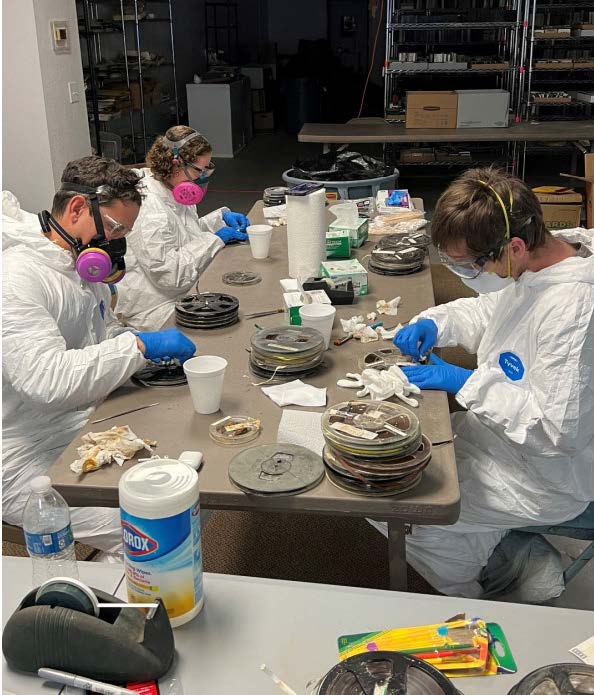
National Heritage Responders and Appalshop Staff salvaging film reels (Photo: National Heritage
Responders Deployment Report 2022)
Tom: There's been a lot of reporting around what happened to Appalshop and to the Hindman Settlement School, but you touched on smaller community organizations and cite a bunch of examples. I'd like to dig into one of them here, the community theater group in Booneville. What happened to them?
Leah: This was a story that hit me deeply as somebody — I grew up in the Missouri Ozarks and was really involved in community theater growing up. When I did the interview with the community theater group in Booneville, Kentucky, they talked about the series of original plays that they had been building over time, and the community looked forward to these plays because the characters were recurring. The one that they were working on right before the eastern Kentucky flooding was called "Inconvenient Dreams," and they said it had volunteer actors from the ages of 9 to 70 years old. So a real diverse pool of the community people involved but also individuals that looked forward to going and experiencing this new play that was about to premiere.
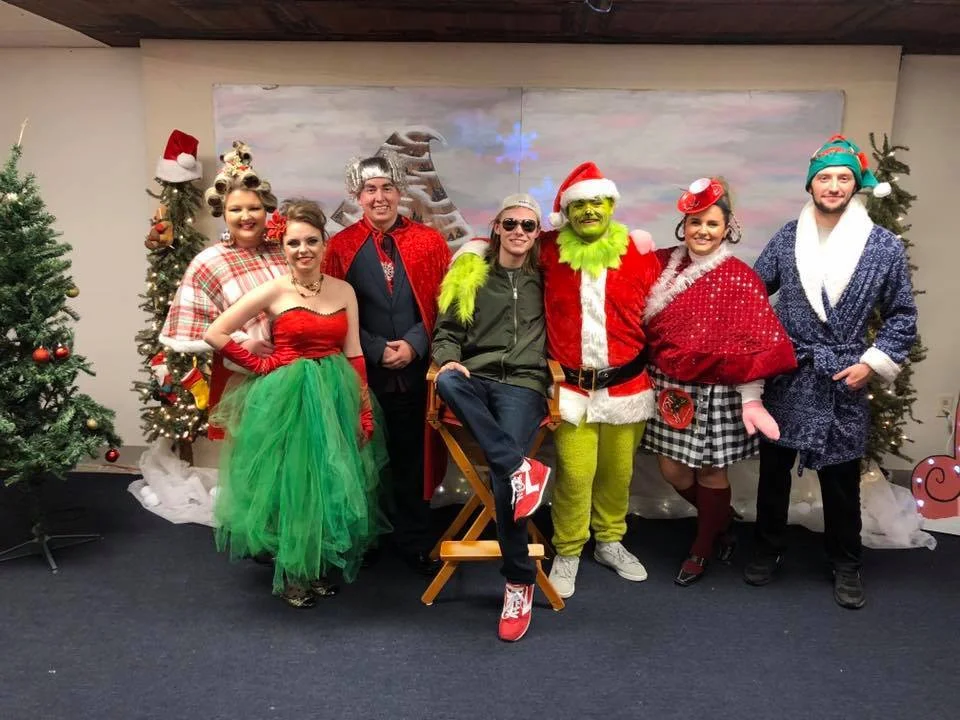
Cast of “Behind the Scenes,” Booneville Theatre Company
And then the flooding hit, and it directly affected the lives of those in the production, losing family members as well as audiences, people that would have come to see the show. So they decided to cancel the show, and it still has not been put on since. The managerial aspect of this, and this is something I highlight in the report, is that it's difficult to navigate this want to provide recovery through arts and culture in a community but also being sensitive to those who have been directly affected by the disaster.
And then there's the logistical side of the work that they were doing to raise money for this facility that they've been renovating in downtown Booneville. So directly, like not having the ticket sales, meant that they were stalled for more than a year. And then that, of course, has the impact of the loss of actual income and projected income, which in the report highlights that that is the biggest sense of loss, not only from individual artists but also arts managers that are working in arts organizations. That the actual income loss but also projected income loss was the biggest area of loss for the arts sector in addition to physical structure and equipment damage.
The Festival of the Mews, a two-day inaugural arts festival with music, art demonstrations, vendors, and food trucks, in Jackson, Kentucky (Breathitt County), was canceled due to too many people grieving after the flooding in Eastern Kentucky. The festival was replaced with benefit concerts in support of those affected by the disaster. The lingering impacts of the flood forced the festival to move out of Breathitt County to Berea, Kentucky (Madison County). Crystal Jones, the festival’s creator, media artist, and founder/host of the award- winning podcast A Mewz in the Mountains, was quoted as saying that the flood “took the artistic energy out of Breathitt.” — Kentucky Arts in Disaster: An Impact Report
Tom: A lot of data was gathered for this report. So let's zoom out and look at the big picture in those numbers: what they can tell us about the impact on the arts of these disasters. What can you tell us about that?
Leah: Sure. We did a survey of Western Kentucky tornado, those affected by the tornado, as well as Eastern Kentucky. So these numbers are aggregate from both of the disasters. A big takeaway, I think we could start with financial. The median loss for an individual artist affected by these disasters was $10,000. So if you're thinking about, okay, as a funder or someone who wants to support [artists], just one artist having a median loss of $10,000, that can tell you the financial impact.
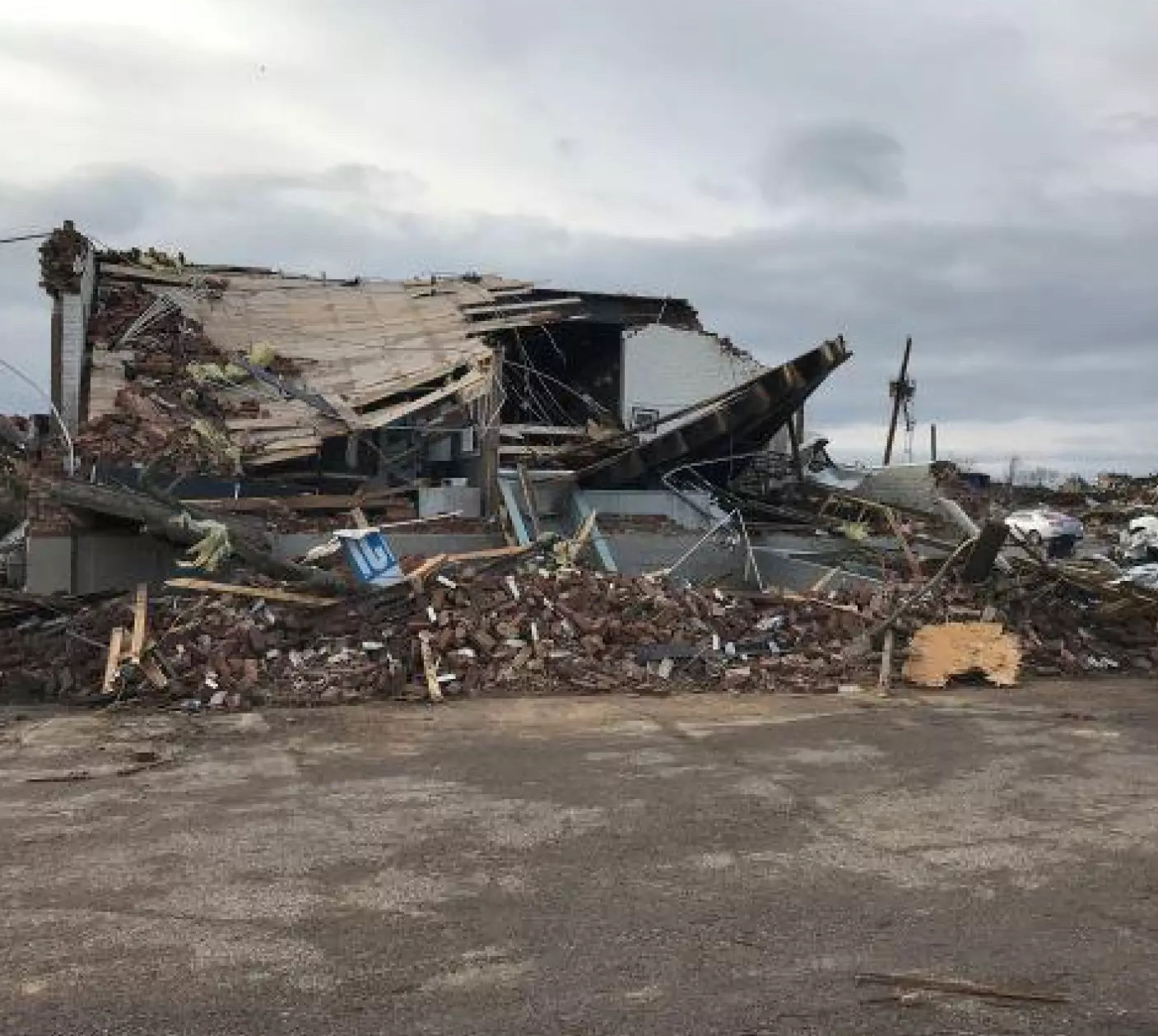
Ice House Gallery in Mayfield, KY after the tornado (Gunn 2021)
Then if we looked at the organizational perspective, $30,000 was the median loss. The range of financial loss was $250 to $5.5 million. So this supports what we know about small businesses. In the United States, a majority of arts organizations are small businesses. Individual artists' studios are small businesses, and the impact of disasters on small businesses means that they can close their doors because of just one significant disaster event and its impact on them financially.
What I also wanted to show in this report was outside of money and those numbers but to also look at the heart and soul of this: the mental health impact and the trauma but also the resiliency of the arts community. That these arts workers in their communities in many ways became social workers and provided their spaces for actors who lost their home to stay or those who needed food or shelter that they opened their facilities to them. So outside of just numbers I wanted to also highlight the role that arts and culture plays in community recovery too in response.
Tom: What did you learn about federal disaster assistance when it applies to the arts?
Leah: So when I was running the focus groups throughout the state, FEMA is a dirty word, but beyond that I was looking at why. I know that it was widely reported that federal disaster assistance is difficult, and this is seen in the report as well. But I think from an arts perspective, under 1%, 0.8% of those applicants that were deemed eligible for FEMA assistance were arts and culture. I'll just let that soak in for a minute, under 1%.
Now, that doesn't account for some arts and cultural organizations that might be part of a city's application for federal assistance. I know that some museums may have partnered with their city, and so I think that's telling. What the report uncovered in interviews is that it was multifaceted. Some people didn't even want to try because it was so complicated. Then there were issues with having to apply for a small business loan first, and then once you're denied that, you can go and apply for FEMA.
But I think even deeper than that is just the deadlines. And then you go deeper than that, that tools that we use as artists are not covered. Before April of 2024 guitars, kilns, things like this, by some caseworkers, were not deemed equipment that would be covered by federal disaster assistance. Now, I will say this is changing because my report is not the only one to uncover this issue with artists and arts organizations. FEMA has since, just in the past few months, is adjusting and has opened for public comment these new policies that would include artistic tools and equipment to be covered.
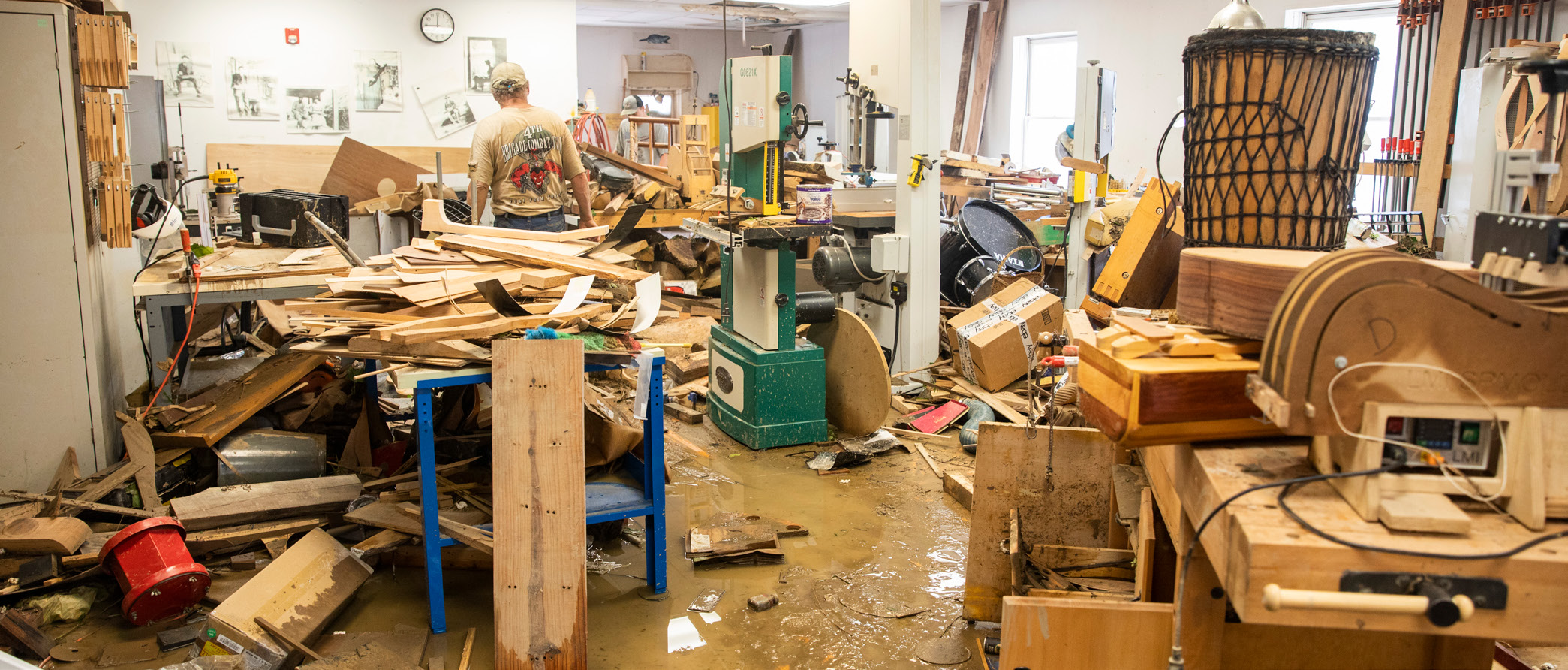
Troublesome Creek Stringed Instrument Company flooding damage (Arden Barnes 2022)
Tom: Taking the federal situation into account, do these experiences with the tornadoes in the west and the floods in the east point to a need for better emergency response and recovery on the state and the local levels?
Leah: I love this question because I see this as, “What does a better response look like?” Any disaster response can be better. We can always build and learn. I think that's maybe the most inspiring part of the trauma behind a disaster event is that we can learn from it, and I heard that from so many respondents and interviewees who wanted their stories to be told so that others can learn from their experiences.
But we have two different sectors. We have the emergency management sector and then we have the arts and culture sector, and our languages are so different. The way we function is so different. We need to connect and build relationships between the two sectors in order for there to be better response. So I think that puts a responsibility not just on FEMA, because in a way, it's kind of an easy way to say, oh, federal assistance needs change. But also, I think it's empowering to think how those in the arts community can get to know their local emergency manager before an emergency or disaster occurs. Every community in Kentucky, every county has an emergency manager, whether it's a volunteer or someone hire.
So I think we can, in the arts sector, try to build relationships and build a stronger bridge, and I think the same goes in the emergency management community. How can they understand the work that we do in the arts? Because as you said, it's very specialized. I heard from a lot of artists and arts managers that they would get upset because when the private companies or disaster agents would come in, they didn't understand that the work that they were doing in those studios had rare wood. 'Don't throw away that rare wood. I need that to build a dulcimer!' They just saw it as a piece of wood. But those that have specialized knowledge in the work of artists and the work of those in preservation, if we can build that body of knowledge in our sector and help train our emergency managers and those in the private sector that do restoration work, I think that's the key to better response.
Tom: Well, it sounds like, as is so often the case, especially in emergency situations, what it often comes down to is communication. It sounds to me as though this needs to be a two-way street. Both emergency folks and the artists themselves need to get better at talking to each other.
Leah: Absolutely, yeah.
Tom: You touched earlier on mental health, and I wonder what you found about the way these disasters affected mental health among surviving artists.
Leah: It's multifaceted because you can come at it from a perspective of using arts and culture in community recovery. I heard this a lot in the interviews and focus groups that the community responded well to arts programming, the Artshine boxes, to having community activities and centers for children that were affected by the disasters, and the role that artists and arts organizations can play in community recovery. From my perspective as an arts administrator and a researcher, I also feel like, okay, we have to support our artists and our arts managers and their mental health so that they can provide that programming to the community.
That's where this gap is right now is for artists that experienced major to total losses of their studios, many of them didn't want to create work, and there was this three- to six-month period of time when they questioned the value of the work they did, if they ever wanted to do it again. I think for funders, there is an opportunity to support artists during that time, to support them until they're ready to create again.
And then from an organizational perspective, I mentioned this earlier, that arts staff — we're talking about teaching artists, fundraisers, marketing directors — became social workers overnight, assisting people, getting their medication, seeing their archives underwater. These are very traumatic experiences. Arts executives, leadership, may not think about that trauma. They're focused on getting the organization back going. But staff members need support in order to work through that and want to continue to follow the mission of their organization. So I think there's work to be done to providing a continuum of care for artists and arts workers after a disaster situation.
“Currently, there isn’t a standard continuum of care for artists and staff of arts organizations affected by disasters. Increased attention for addressing mental health concerns as part of disaster assistance could address staff turnover and loss of creative and cultural resources caused by the effects of disaster trauma.”
— Kentucky Arts in Disaster: An Impact Report
Tom: Well, I had thought that we might run through the nine findings that you list. However, we're up against time. But let's touch on a couple of highlights that stand out to you, and I don't want to be dismissive of any of them, but is there anything in particular, Leah, that you'd like to communicate here?
Leah: Well, I think learning opportunities. Many organizations and artists really showed an interest in wanting to learn how to salvage archival material. What are the disaster assistance agencies that exist federally, locally, statewide, regionally? How do we work with them? What does that process look like before an emergency or a disaster occurs? I think it's a very tangible thing that we can do to help artists with resources and arts organizations with more knowledge about this.
We at the Department of Arts Administration at the University of Kentucky have been working in this area for a number of years. We've offered a full-time course for our master's program since 2017. But because of this research, we know that it needs to be broader, this training. So we've partnered with the University's Extension Service and we've started to offer regional trainings. We're excited about this and we've launched now a certificate program in Arts Emergency Management that's 12 hours. I think having these learning opportunities both from practitioners but also individuals that are wanting to learn more through an academic institution, I think that's going to move the needle to addressing some of those needs that we identified in the report.
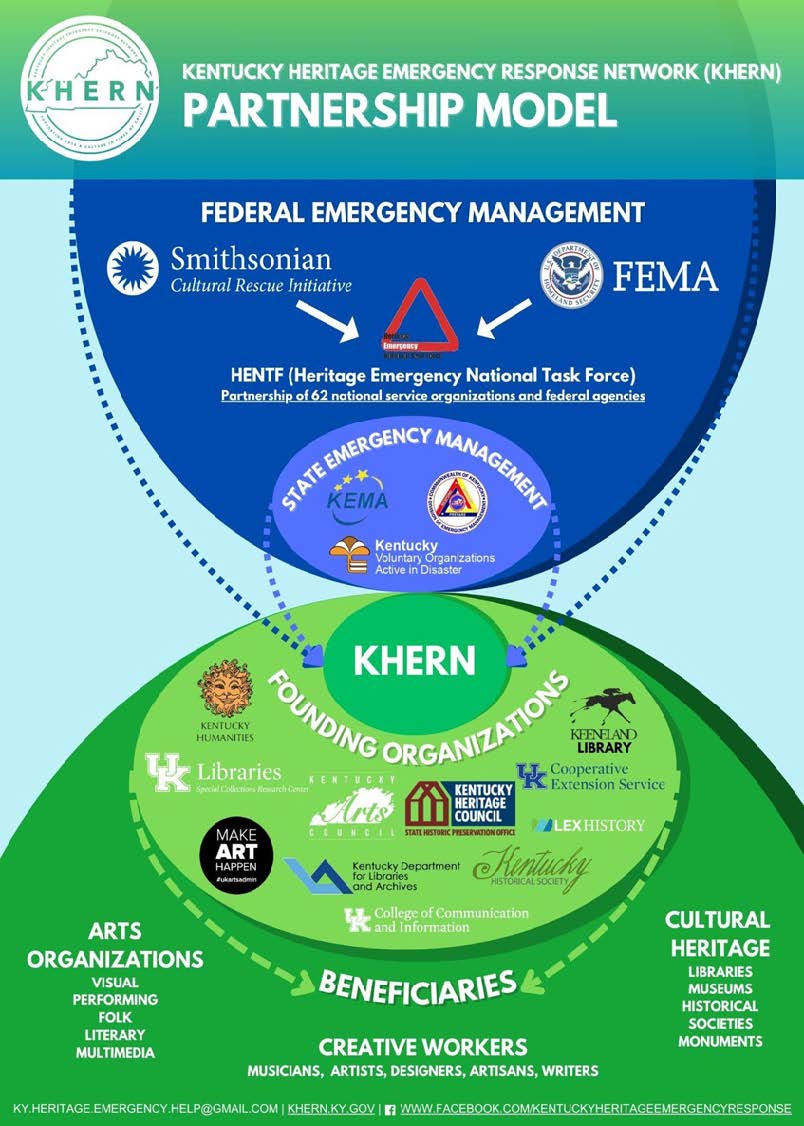
I also would like to highlight the work that has happened since the tornado and the flooding, and it sort of was born out of these disasters. That is an initiative lovingly called KHERN, the Kentucky Heritage Emergency Response Network. This is dedicated individuals throughout the state that have specialized knowledge in arts and culture and that want to connect people on the ground to resources more quickly when the next disaster occurs or emergency occurs, specifically in any area. So I think this initiative will help cut down some of that frustration that was discovered in this report of how to navigate working with federal agencies, understanding what funding opportunities there are and navigating and getting that convergence. It's overwhelming in the beginning of a disaster. All these agencies want to provide support but don't know exactly know how, and KHERN can be that middle agency to help connect those on the ground to resources at the state and federal level.
Tom: All right, that's Leah Hamilton, Assistant Professor of Arts Administration at the University of Kentucky. We thank you so much for this really important work and especially for sharing it with us.
Leah: I appreciate you giving it time and awareness. Thank you.
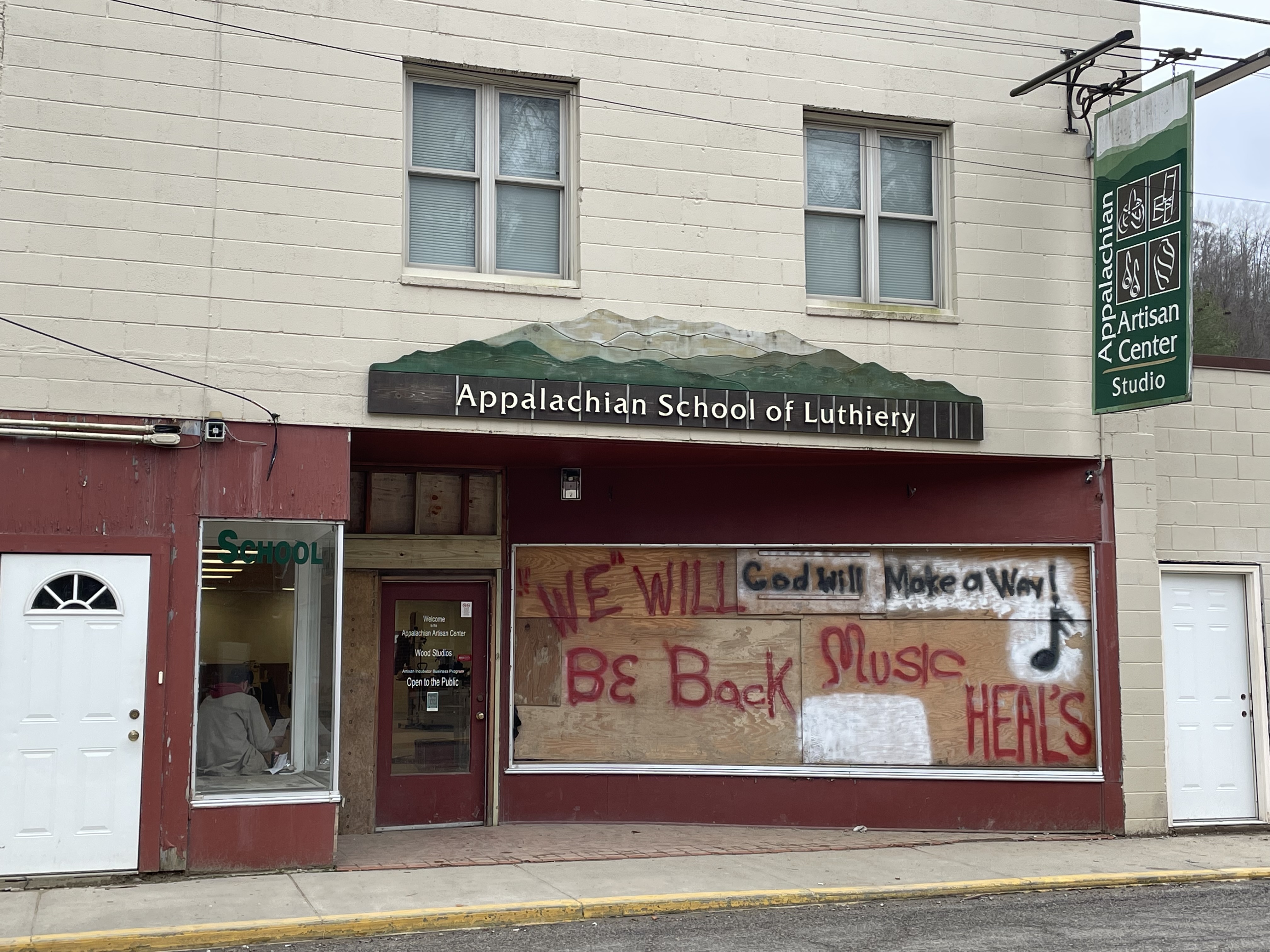
Appalachian School of Luthery on West Main Street in Hindman, Kentucky (Photo by Jeanne Marie Hibberd)